Why BFS Technology Matters in Ophthalmic Manufacturing
Sterile ophthalmic products require carefully controlled manufacturing and packaging because the product is intended for direct application to the eye. ophthalmic manufacturing therefore places strong emphasis on contamination control, consistent filling, container integrity and reliable production processes. Blow-Fill-Seal (BFS) technology addresses several of these requirements by integrating container formation, product filling and sealing into a controlled automated process.
For ophthalmic manufacturers, this approach can reduce unnecessary handling and support consistent packaging. It is particularly relevant for sterile liquid products where maintaining product integrity from filling through final sealing is an important part of the manufacturing process.
What Is Ophthalmic BFS Technology?
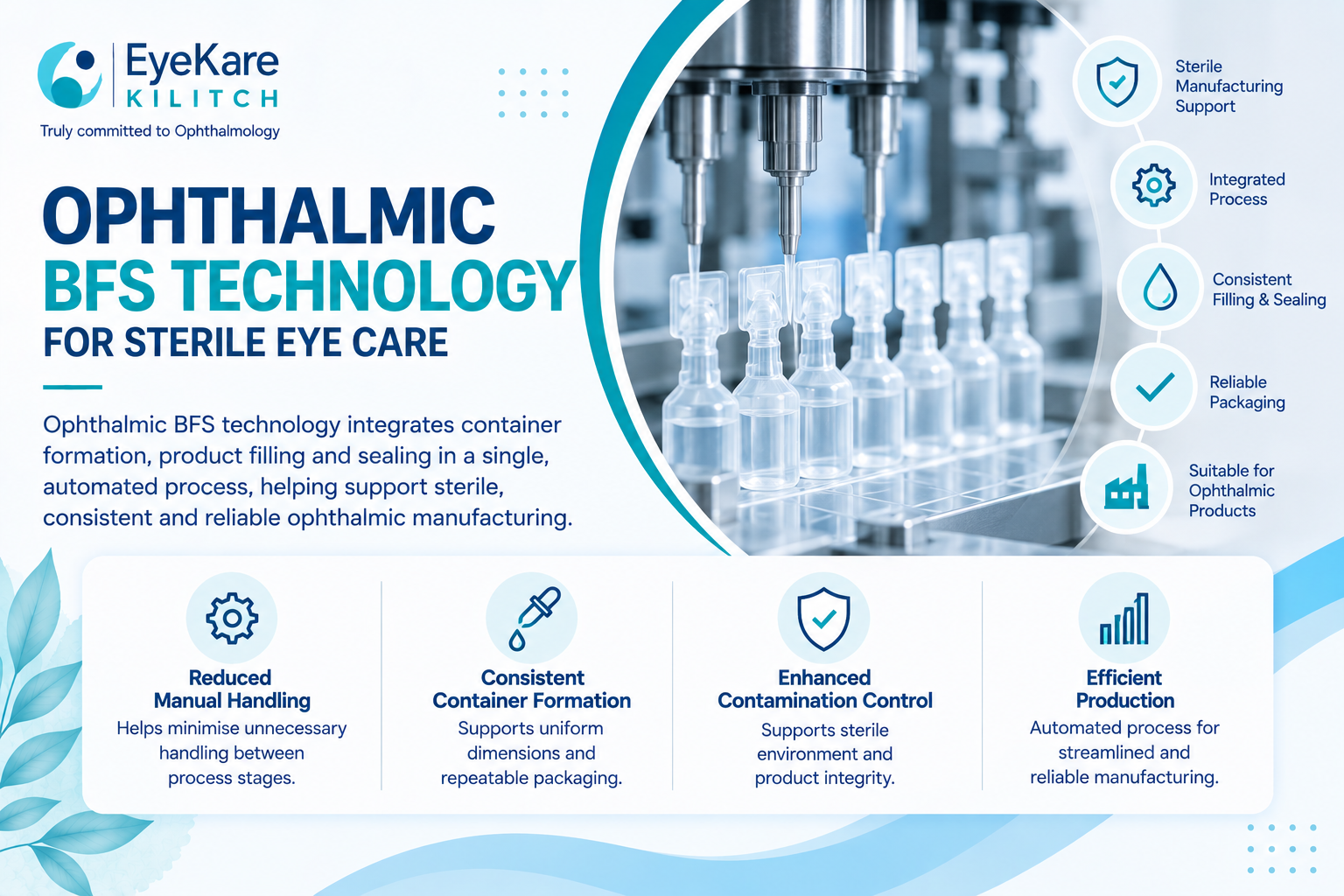
Blow-Fill-Seal technology is an automated manufacturing process in which a plastic container is formed, filled with the product and sealed within one integrated sequence. Instead of preparing empty containers separately and transferring them through multiple handling stages, BFS equipment performs these key steps as part of a continuous operation.
In ophthalmic manufacturing, the technology can be used for suitable sterile liquid products and single-dose packaging formats. The exact configuration depends on the formulation, container design, required fill volume, material compatibility and validated manufacturing process.
The main advantage is process integration. By reducing manual intervention between container formation, filling and sealing, BFS can support a controlled production environment and consistent unit-to-unit packaging.
How the BFS Process Works
1. Container Formation
The process begins with a suitable polymer material that is heated and formed into the required container shape. The container is created directly within the BFS equipment according to the approved design and dimensions.
2. Product Filling
Once the container is formed, the ophthalmic formulation is filled into it through a controlled filling system. Fill volume and process parameters are monitored to maintain consistency across units.
3. Sealing
After filling, the container is sealed within the same integrated process. This creates a finished unit without requiring a separate conventional capping operation.
4. Inspection and Quality Control
Finished units are subject to appropriate inspection and quality checks. Depending on the product and validated process, checks can include container integrity, fill volume, appearance and other defined quality attributes.
Key Benefits of BFS Technology for Ophthalmic Products
Reduced Manual Handling
Because container formation, filling and sealing are integrated, BFS can reduce the number of manual handling stages between packaging operations. Lower handling can support contamination-control strategies when the process is properly designed and validated.
Consistent Container Formation
Automated container production helps maintain defined dimensions and repeatability. Consistent container geometry can support reliable filling and sealing across production batches.
Integrated Filling and Sealing
The combined process reduces the need to move open containers between separate production stages. This is especially relevant when sterile product protection is a major manufacturing consideration.
Efficient Production
BFS systems can integrate multiple packaging operations into a single automated process. This can support streamlined production and reduce unnecessary intermediate handling.
Suitable for Unit-Dose Formats
BFS can support compact single-dose container formats for appropriate ophthalmic products. Such formats can be useful where controlled individual dosing and convenient packaging are required.
BFS Technology and Sterility Control
Sterility cannot be attributed to equipment technology alone. A BFS system forms part of a broader validated manufacturing process that includes facility controls, environmental monitoring, raw material controls, sterilization or aseptic processing requirements, validated procedures and quality assurance.
The value of BFS is that it can reduce open handling and integrate key packaging steps within a controlled system. This can complement the wider contamination-control strategy used for sterile ophthalmic manufacturing.
Manufacturers must establish and validate the process according to the product, equipment, packaging material and applicable quality requirements. Routine monitoring and documented controls remain essential to maintaining consistent manufacturing performance.
Applications of BFS in Ophthalmic Manufacturing
BFS can be considered for suitable sterile ophthalmic liquids where the container format, formulation and manufacturing process are compatible with the technology. It may support sterile eye drop manufacturing by combining packaging operations and reducing intermediate container handling.
Single-Dose Ophthalmic Products
Single-dose formats can benefit from integrated container formation and sealing. The final packaging configuration should be selected according to product requirements, dosing needs and validated stability considerations.
Unit-Dose Lubricating Products
Appropriate ophthalmic lubricating formulations may be packaged in unit-dose formats where the formulation and container system are suitably developed and validated.
Other Suitable Sterile Liquids
Depending on formulation and packaging compatibility, BFS can be considered for other sterile liquid ophthalmic products. Product-specific development and validation are required before commercial manufacturing.
Factors to Consider Before Selecting BFS Technology
Formulation Compatibility
The formulation must be evaluated for compatibility with the selected container material and manufacturing process. Stability, extractables and leachables, adsorption and other relevant product-package interactions may need assessment.
Container Design
Container shape, wall characteristics, dispensing configuration and closure design influence the suitability of the BFS process. The package should support the intended use while maintaining required product protection.
Production Requirements
Expected batch sizes, fill volumes, packaging formats, equipment capacity and future production requirements should be considered when evaluating BFS infrastructure.
Quality and Validation
Equipment qualification, process validation, cleaning controls, environmental controls and container-closure integrity considerations should form part of the overall quality strategy.
Quality Control in BFS-Based Ophthalmic Manufacturing
A robust BFS operation requires defined quality controls across materials, equipment, process parameters and finished products. Controls should be established through the manufacturer’s quality system and validated procedures.
Depending on the product, relevant checks may include fill volume, appearance, container integrity, microbial and sterility-related testing, stability evaluation and other product-specific quality attributes. Environmental monitoring and process monitoring are also important components of sterile manufacturing.
Documentation is equally important. Batch records, equipment qualification, maintenance, calibration, deviation management and change control provide the traceability required for consistent pharmaceutical production.
Why the Right Manufacturing Partner Matters
BFS equipment is only one component of a successful ophthalmic manufacturing operation. The manufacturer’s formulation expertise, sterile processing capabilities, quality systems, packaging development, validation practices and regulatory knowledge all influence the final product.
For brands, distributors and healthcare businesses evaluating an ophthalmic manufacturing partner, it is therefore important to assess the complete production ecosystem rather than viewing BFS as a standalone machine. A capable ophthalmic manufacturing partner should be able to align technology, formulation, packaging and quality requirements with the intended product and market.
Conclusion
Ophthalmic BFS technology integrates container formation, product filling and sealing into a controlled automated process. For suitable sterile ophthalmic products, this approach can reduce intermediate handling, support packaging consistency and contribute to an effective contamination-control strategy.
However, BFS performance depends on more than the equipment itself. Formulation compatibility, container design, process validation, environmental controls, quality testing and ongoing monitoring must work together to deliver a reliable finished product. Choosing an experienced ophthalmic manufacturing company with appropriate technology and quality capabilities can help manufacturers develop and produce ophthalmic products with consistent process control and packaging integrity.